4 ways crochet (accidentally) made me a more patient person
When I was about 8 years old, I remember standing in line to get ice cream with my family. It was a Sunday after church, and the outdoor stand was packed. It was hot out, muggy, humid. I could feel my itchy church clothes around my neck and my pleather Mary-Janes were hurting my feet as we stood in line. I wasn’t the only one feeling restless. I could sense the feeling rising in my dad beside me, which wasn’t good. If he decided that the line was too long, we’d be leaving.
“Patience is a virtue,” I remember my mom saying in his direction, sensing his unease.
“Patience,” I remember him responding clearly, “is a virtue I don’t have.”
As a child, you’re told to be patient a lot. On road trips, at the McDonald’s drive-thru, in the lineup to leave class for recess. But this was the first time I’d heard anyone just…admit that they weren’t patient. Especially an adult! Especially my dad!
Unbeknownst to him, that moment and those words became my credo for years. Anytime anyone told me to be patient I would tell them that I don’t have the patience bone — if I wanted something, I wanted it now. This followed me into adulthood. I made friends with bouncers so I wouldn’t have to wait in line at bars, I’d skip class in university to go to the mall after seeing a classmate wearing a pair of shoes I wanted, I’d decide to cut my hair at 10 a.m. and have bangs by noon.
Needless to say, I had a problem with waiting for things to happen.
That is, until I started crocheting.
Crochet doesn’t happen overnight (although I’ve really tried to make it work). It takes time, effort, patience. I learned a lot about myself when I picked up a hook. Let’s talk about it.

Image from unsplash.com
Embracing the beginner stage
Unfortunately, I was really good at school (stay with me here, I promise I’m making a point). Things came easily to me, teachers loved me, and it didn’t take me long to memorize what I needed for a test and move on.
I say unfortunately because it made me a good studier, but not a great student. As a result, I struggled with things that I didn’t immediately understand. One time I had a class-long argument with my high-school gym teacher that basketball took absolutely no skill and players relied solely on luck. You can guess how good I was at basketball (spoiler alert, I failed the basketball unit that year).
I’ve committed to a lot of my hobbies for years simply because I’m good at them. I became a writer because it has always come easily to me, I played rugby for a decade because the game made sense to me, and I’ve been painting in every way you can imagine since I was a toddler. It’s not a bad thing to stick with something you’re good at. All of these hobbies brought me a lot of joy, or course — but I wasn’t challenging myself.
The first day I ever tried to crochet, I crocheted two rows of 20 stitches and then decided that I knew everything (second spoiler alert, I knew absolutely nothing). What came next was months of grappling with projects — learning how to do turning chains, count my stitches correctly, master the three basic stitches, read patterns, and so much more.
I spent the first month of learning crochet going back and forth between wanting to throw my project off my balcony and being so obsessed with it that I’d be up all night googling ways to get neater stitches. It was the first time I’d committed to doing something that I wasn’t immediately good at, and it felt kind of liberating. Crochet is something I had to work at — I had to become a student of it. And, as a result, the end product just feels that much sweeter.
Choosing progress over pace
Because crochet is my hobby, sometimes real life gets in the way. Work, going to the gym, hanging out with friends and family — most of these take precedence over fashioning some yarn into a hat.
Previously, if I spent too much time away from a project that I was writing or painting or reading, I would forget about it. I was an all-or-nothing type of person. If I couldn’t get it done in a weeknight or a weekend, chances are it wasn’t happening.
Doing things quickly had always made room for mistakes, and the same was true for crochet. I’d get five hours into a project and realize that I dropped a stitch on the third row. During the first few months, I feel like I was racing to the finish line, but the big red ribbon at the end was just crippling carpal tunnel and the range of motion of an 82-year-old. I needed to slow down or I was going to need to wear a wrist brace — a fashion faux-pas I would never succumb to. It forced me to put the hook and skein down, take a few hours or a couple days away from it, then come back and see it in a new light.
I’ve translated it to my real life — taking a second to re-read my friend’s text before responding, leaving a work project over my lunch break to mull over what direction to take it in, sleeping on a purchase to decide if it’s something I really need.
It turns out the world doesn’t end when I wait. In fact, everything gets a little easier; my stitches, my decisions, my conversations. Crochet nudged me into a rhythm where slowing down isn’t laziness, it’s clarity.
Fidgeting, but make it craft
Do you remember the fidget spinner craze of 2017? It felt like you couldn’t go anywhere without seeing the little spinning tops in people’s hands, pockets, and desk drawers. The world was fully embracing fidgeting as a mindfulness practice. Sadly, fidget toys have since been debunked as a method to reduce stress and improve focus.
But, the story changes when we look at studies on “fidgety” tasks that produce an end result. A 2025 review of 19 crafting hobbies (such as pottery, knitting, embroidery, papercraft and woodwork) found that every study reported short‑term improvement in feelings like anxiety, depression, mood, self‑esteem and life satisfaction.
Keeping my hands busy is nothing new to my life, I’ve always loved having a hobby to turn to when things get hard. Crochet is repetitive, it can sometimes be a little bit mindless. It’s something easy to do when you throw on a show or a podcast. It keeps your mind and hands busy without requiring a bunch of tools.
That’s where crochet fits so neatly into my life. It gives my restless hands something to do while my mind finally gets a chance to soften. It’s not a gimmick or a trend — just a quiet, steady way to feel grounded again.
Frogging as a life skill
Early into my crochet journey, I decided to make my cousin a sweater. Her birthday was coming up, and because of COVID I couldn’t visit her anytime in the near future. It felt like the perfect cozy gift to send her way.
Long story short, I messed it up real bad. I used the wrong weight of yarn, I miscalculated all of my stitches, my rows wouldn’t lay flat, nothing lined up when I went to stitch it together, and the sleeves somehow ended up long enough to hit her at the knee. It just came out all wrong.
It was my first experience with frogging. And before you ask, no, it doesn’t have anything to do with a certain acclaimed SEGA video game from 1981.
Frogging means unraveling your project, or undoing your stitches. Crafters call it “frogging” because when you undo your stitches, you’re “ripping it out.” Repeat “rip it” enough times — “rip it, rip it” — and suddenly you sound like a little yarn frog. The name was inevitable.
After frogging my ill-formed sweater, I switched lanes. I made my cousin a better sweater, with better yarn, better techniques, and a better outcome. She kept that sweater on her desk chair for years, and I loved seeing it there when I visited her.
My first encounter with frogging definitely wasn’t my last, a lot of my projects have been frogged since then. But, it’s taught me that some projects fall apart so better ones can take shape.
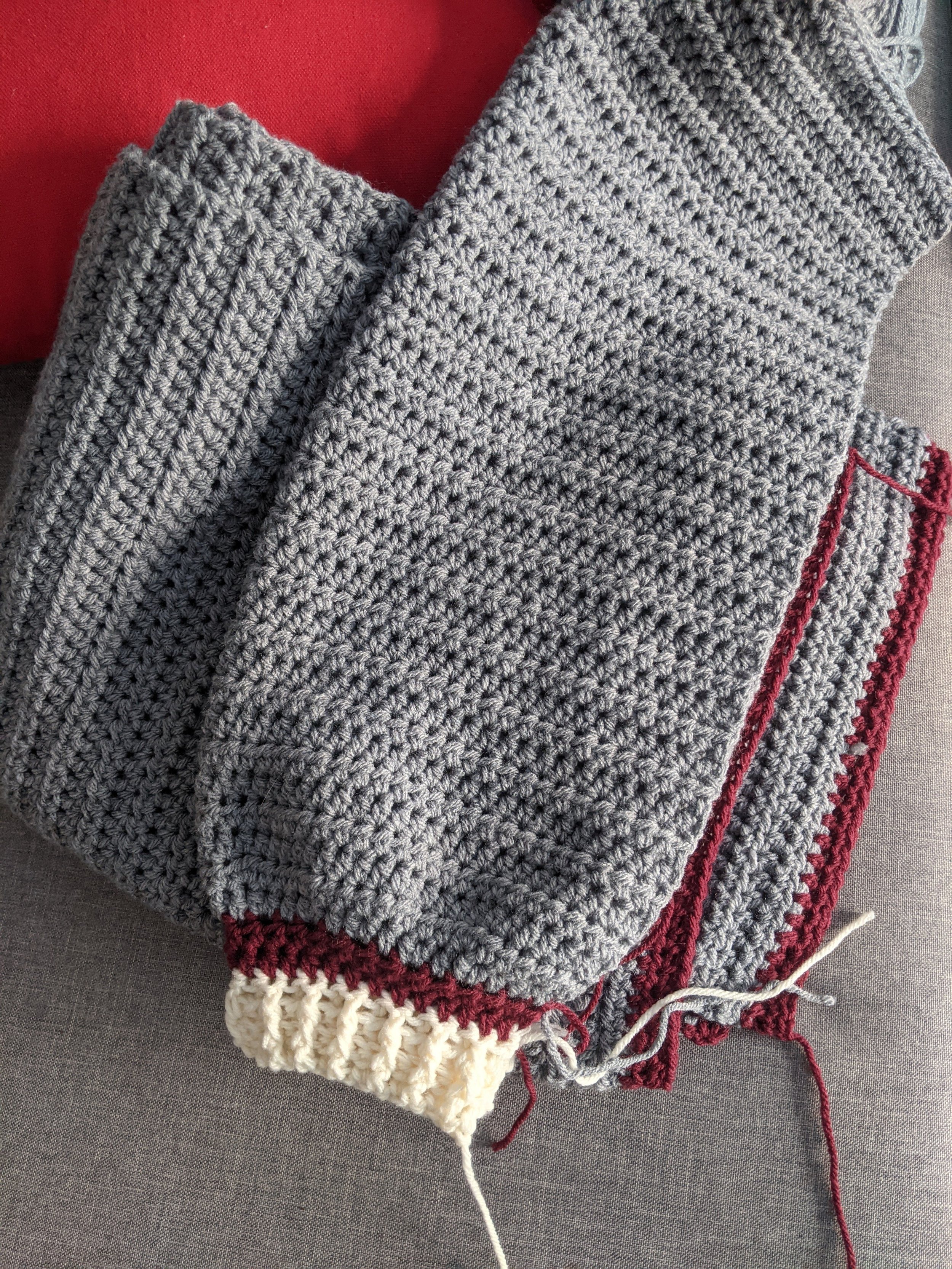
The second (successful) cardigan I made for my cousin—unfinished, but close to it.
TL;DR: crochet fixed me (ish)
Crochet didn’t magically make me a patient person. I still get annoyed when I’m sitting in traffic, I don’t love being stuck at the self-checkout behind someone with the whole store in their cart, and I still refuse to wait in line at bars.
But, crochet did teach me how to slow down, pay attention, and start again when I need to. I’m not perfect at it — far from it — but each project leaves me a little steadier than the last. And for someone who once claimed she didn’t have the patience bone, that feels like a small, quiet triumph.
