The crafting traditions that built Nova Scotia homes and culture
Every year, at Christmastime, I see a little tag on my stocking—it reads, “Made by Susan”, my aunt. In a photo propped on a shelf in our dining room from my first communion, my sisters and I are wearing handmade dresses sewn by my Aunt Paula. Every winter, I bring out the knitted socks my godmother, Aunt Lori, gave me years ago.
Everywhere I look, I’m reminded that I come from a family where making things wasn’t just a hobby. It was—and still is—a way of showing care, solving problems, and expressing creativity.
My family is from Nova Scotia, a mostly Irish-and-Scottish settled province with a rich history of textile art. As I’ve learned more about Nova Scotia’s craft history, it’s become clear that these family practices are not isolated. They’re part of a larger regional tradition shaped by resourcefulness, climate, community, and generational learning. To explore this connection more deeply, I spoke with my mother, Nan—a quilter and rug-hooker herself—about what handwork meant in her childhood, and how those traditions continue today.
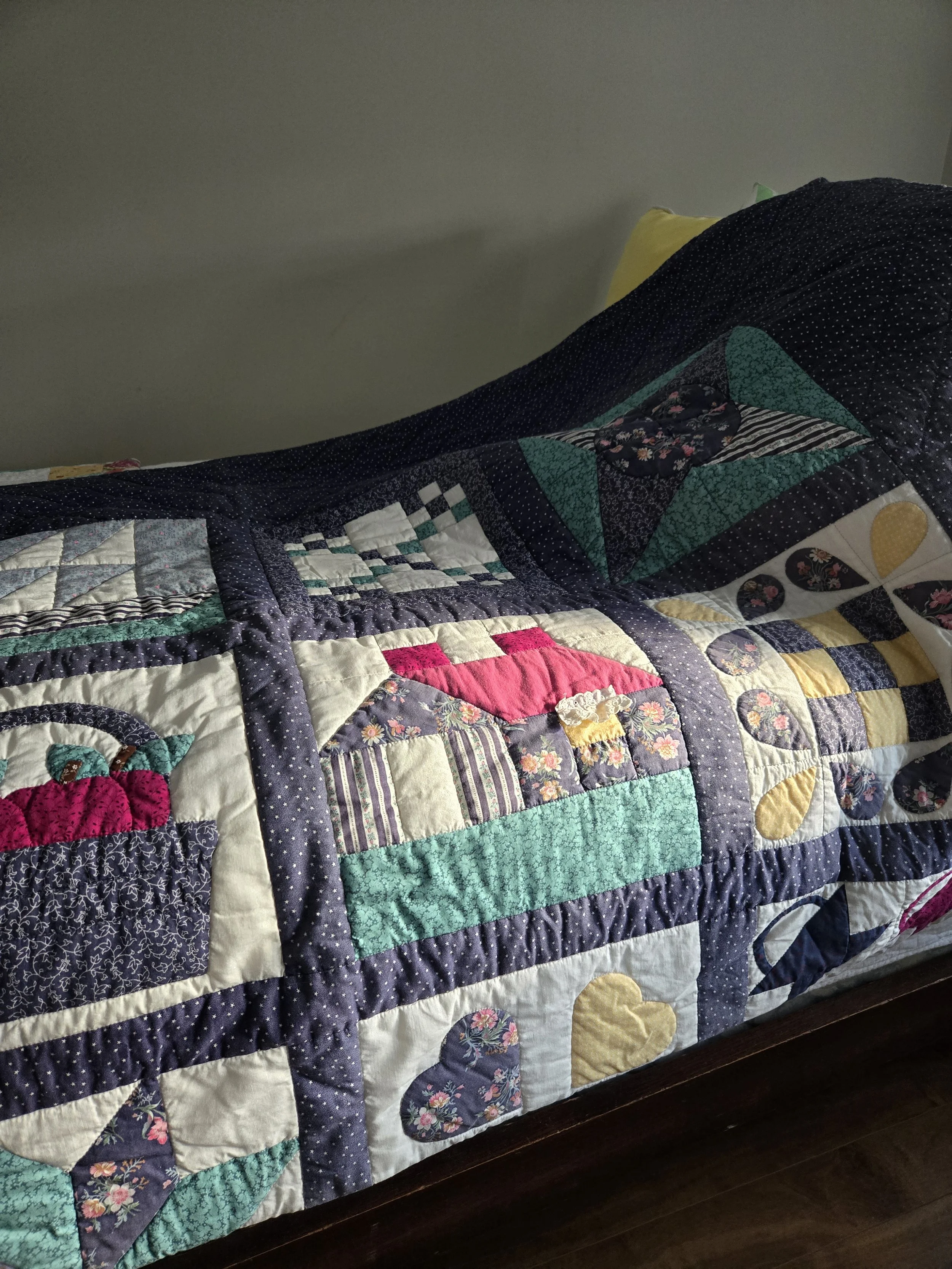
My aunt’s (if you can believe it) first-ever quilt that she made decades ago!

As mentioned, THE comfy knitted socks that come out every winter.
Crafting in Nova Scotia: A region shaped by necessity and skill
Nova Scotia has long been recognized as a center for textile craft, with organizations like Craft Nova Scotia noting that sewing, quilting, knitting, and rug hooking were essential domestic skills well into the mid-20th century.
The reasons were primarily practical, including:
long, harsh winters
rural geography
limited access to manufactured goods
a culture of reuse and repair
Quilting, for example, played both a functional and social role. Quilting bees were common community events where women gathered to finish a quilt in a single day—a blend of labor, socializing, and mutual support. Scholar Kathryn DeLong describes quilting in Atlantic Canada as a practice “rooted in domestic necessity but elevated through community ritual.”
Rug hooking also has deep roots in the Atlantic provinces. It began as a frugal method of repurposing burlap feed sacks and leftover wool into warm floor coverings, eventually evolving into a distinctive folk art now celebrated in museums and galleries. Sharon Andrea’s research on rug hooking in Atlantic Canada traces this evolution from “functional object to culturally significant textile art.”
These traditions form the backdrop of my family’s craft practices.
A family of makers
When I spoke with my mother, she explained that crafting was simply “part of running a home.” Her mother crocheted blankets and sewed clothes for her and her five siblings. Additionally, her sisters all learned these necessary skills as well.
This intergenerational mix of skills mirrors historical accounts that describe textile knowledge in rural Nova Scotia as informally transmitted—learned through observation rather than instruction. Heather Fry’s social history of home craft in Canada outlines how families relied on “domestic apprenticeship,” where children absorbed skills by watching adults work.
My mother’s memories reflect this exactly. No one sat her down to teach her how to hem, sew, or quilt. She picked it up by being present, participating, and eventually contributing. She also notes that, in those days, “everyone had to take home economics,” where they would learn the basics of sewing, cooking and cleaning.
These family traditions continue today—my sister knits, my cousins sew and quilt, and I’ve taken up crochet. None of us really remember being taught, or taking a class, it’s just something we started doing because the women in our family were the people we looked up to. The skills may have evolved into creative hobbies rather than necessities, but the impulse is the same.
From household obligation to creative choice
One of the most interesting themes I uncovered was my mother’s observation about how crafting has shifted over time.
“We made things because we needed them,” she told me. “People now make things because they enjoy it.”
This reflects a broader trend across Canada. As manufactured textiles became widely accessible in the late 20th century, domestic crafting gradually transitioned from essential labor to creative practice. Yet, the cultural memory of those earlier traditions persists.
Today, quilting and rug hooking in Nova Scotia are not only hobbies—they're recognized art forms with dedicated guilds, workshops, and exhibitions. Knitting and crochet have resurged globally thanks to online communities and social media. What once ensured warmth and thrift now offers fulfillment, identity, and connection.
But the throughline remains. Creating something by hand carries meaning, whether the motivation is economic, cultural, or emotional.
Craft as cultural continuity
My mother’s experiences reinforce several key trends in Nova Scotian craft history:
1. Crafting was a household norm, not a niche activity
Nearly everyone in her family had a textile skill, which aligns with regional patterns where domestic self-sufficiency was essential.
2. Skills were passed down quietly, through doing
This matches documented “apprenticeship-by-observation” models found in rural Canadian craft traditions.
3. Both practicality and pride shaped textile work
Whether crocheting blankets or sewing dresses, the work combined necessity with aesthetic expression—exactly as described in maritime craft scholarship.
4. Modern crafting still carries historical weight
Even though today’s makers craft for pleasure, the cultural value of handwork persists across generations.
Crafting as a living regional heritage
What began as a simple reflection on my stocking tag and childhood dresses revealed a much broader truth: crafting in my family is part of a larger Nova Scotian story. It reflects a regional identity built on resourcefulness, creativity, and community—a history still visible in the handmade objects we keep, gift, or use.
Interviewing my mother made it clear that crafting isn’t simply something we do. It’s something we inherit.
AI Sources
“What are some stats that would support this blog” prompt. ChatGPT-5.1. Accessed Dec. 8.
