Why people start (and stop) crafting: What a small poll reveals
Crafting has exploded across TikTok and Instagram, from crochet to quilting to embroidery. But I wanted to understand why people start crafting—and just as importantly, what stops them. To explore this, I ran a short anonymous Google Forms poll with 14 respondents from my personal and professional networks. The poll included eight neutral, unbiased questions.
While the sample isn’t representative of the broader population, it still offers meaningful insight into how people relate to making things by hand.
Do people actually craft?
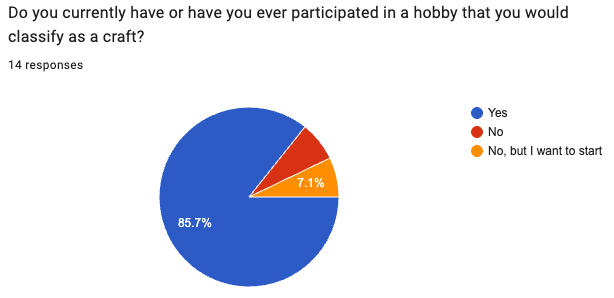
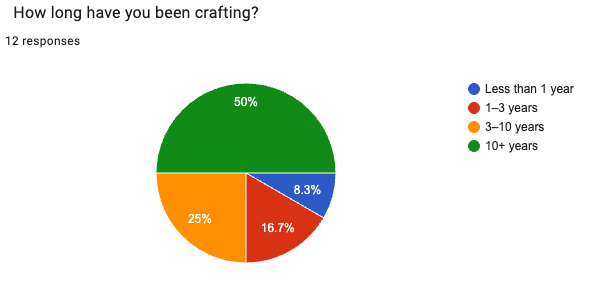
85.7% of respondents said they currently, or have in the past, engaged in a craft hobby. Half of them have been crafting for 10 or more years, suggesting that craft is often a long-term, meaningful part of people’s lives, not a fleeting hobby trend.
Why do people start crafting? Turns out, creativity leads the way.
When asked what originally motivated them to pick up a craft, the top responses were:
Creativity and self-expression (91.7%)
Stress relief / mental health (50%)
To make gifts (50%)
This reflects what many makers say: crafting feels good, offers emotional regulation, and provides an outlet for imagination. Surprisingly, zero respondents said social media inspired them to start—which pushes against the “TikTok made me do it” narrative around crafting trends.

Barriers to crafting—time, cost, and intimidation
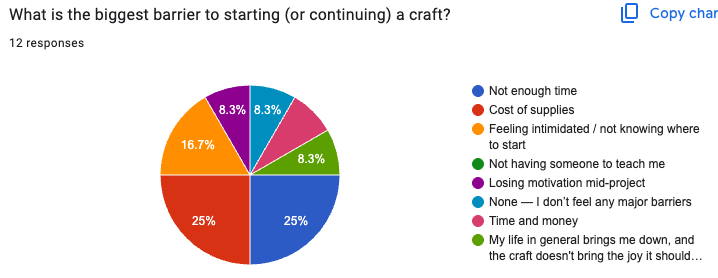
Respondents who do not craft—or who struggle to maintain the habit—reported barriers such as:
Not knowing where to start
Lack of time
Cost of supplies
Feeling intimidated
These results confirmed my expectations: the issue isn’t lack of interest, but lack of accessible entry points.
How do people learn how to craft?
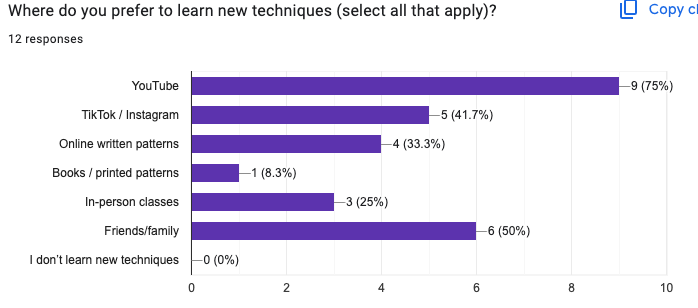
The most popular learning sources were:
YouTube (75%)
Friends or family (50%)
TikTok/Instagram (41.7%)
This aligns with the explosion of craft tutorials online and the importance of community-based knowledge sharing.
Crafting habits are mostly solo, and mostly successful
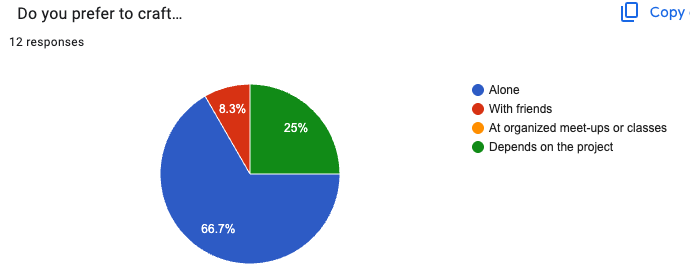
Two-thirds of respondents prefer to craft alone, though many said their preference depends on the project. And encouragingly, 83% finish their projects “most of the time.”

Limitations of the poll
Small sample size
Respondents were primarily people already interested in crafting
Results may not reflect people with very different backgrounds or demographics
That said, the insights still highlight meaningful patterns.
What the results suggest
Overall, the results supported what I suspected: people craft because it feels good—emotionally, creatively, and mentally. The biggest barriers aren’t desire, but access and confidence. The more we can demystify crafting for beginners, the more people will feel empowered to try it.
AI Sources
“Analyze these google form responses for concise analysis” prompt. ChatGPT-5.1. Accessed Dec. 8.
